
Introduction
Tires are one of the most critical yet often less spoken about components in motorsports. In IndyCar, Firestone provides the standard tire, meaning every team must work with the same compounds. Despite this, tire strategy plays a massive role in determining race outcomes, influencing everything from pit stop timing to overtaking opportunities.

The Compounds
Firestone provides two dry tire compounds per race weekend:
- Primary (Black Sidewall): More durable, slower degradation, lower grip.
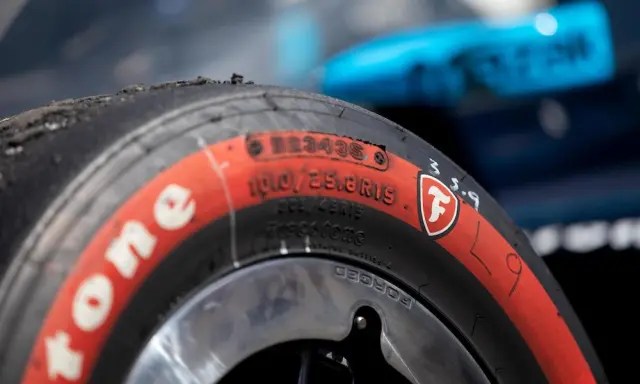
- Alternate (Red Sidewall): Softer compound, higher grip, faster degradation.
Additionally, rain tires (Grooved) are used for wet conditions, but they are outside the scope of strategic compound decisions for dry races.
Each driver must use both the primary and alternate compounds during a race, making compound selection and wear management vital for success and strategy.

The Make Up
1. Polymer Composition and Elasticity
Firestone engineers create tire compounds by mixing synthetic and natural rubber with fillers like carbon black and silica. This balance determines how the tire interacts with the track surface:
- High Silica Content: Increases flexibility and grip, commonly found in alternate tires.
- Carbon Black: Enhances durability and wear resistance, a key component in primary tires.
2. Temperature Sensitivity and Thermal Degradation
- Softer tires (alternates) reach optimal temperatures quickly (~80-120°C) but overheat faster, leading to blistering.
- Harder tires (primaries) have a wider temperature operating window (~90-140°C), making them more stable over longer stints.
A driver who overheats their tires by sliding too much or pushing too aggressively may experience thermal degradation which reduces grip and increases lap times.
Tire Wear and Degradation
IndyCar teams classify tire degradation into two primary categories:
- Physical Wear (Tread Loss):
- Caused by mechanical abrasion with the track surface.
- More severe on high-degradation circuits (e.g., street courses like Long Beach).
- Measured using tread depth gauges post-stint.
- Chemical Wear (Compound Breakdown):
- Occurs when excessive heat alters rubber elasticity.
- Can lead to graining (small rubber marbles forming on the surface) or blistering (bubbles forming due to excessive internal temperature).
Race Strategy with Tire Compounds
1. Pit Strategy
IndyCar races often include 2-3 pit stops, meaning teams must decide:
- When to switch from alternates to primaries.
- Whether to start on the faster but fragile alternates or the steady primaries.
On a street circuit, a team may opt for:
- Soft-Soft-Hard Strategy (Aggressive): Maximizing early pace and building a gap before switching to a conservative final stint.
- Hard-Soft-Soft Strategy (Undercut Focused): Running longer first, then exploiting fresh alternate tires to gain positions.
2. Undercut vs. Overcut
- Undercut: Pitting earlier for fresh tires to gain time on worn-tire competitors. Works best with alternates on a degrading track.
- Overcut: Staying out longer to exploit opponents’ degraded tires before making a late pit stop. Primaries are usually better for this approach.
3. Track-Specific Tire Considerations
Some circuits favor certain compounds:
- Street Circuits like Toronto and St. Petersburg have high tire wear where softs degrade quickly requiring more reliance on primary tires.
- Superspeedways such as the Indianapolis 500 have minimal degradation but the heat management is crucial. It requires a focus on heat cycles rather than tire wear.
- Road courses like Mid-Ohio and Laguna Seca require both strategies listed above as they include both conditions.

The Role of Data Analytics in Tire Management
1. Real-Time Telemetry and Tire Performance Monitoring
IndyCar teams use real-time telemetry to track:
- Tire surface temperatures (via infrared sensors).
- Tire pressures (higher pressures reduce rolling resistance but decrease grip).
- Lap time deltas to identify optimal pit windows.
2. Degradation Models and AI Simulations
Advanced machine learning models process historical tire data to predict:
- Projected degradation per lap based on track temperature, fuel load, and driving style.
- Optimal tire life expectancy to determine when to pit.
- Comparative performance vs. rivals to adjust strategy mid-race.
3. The Role of Driver Feedback
Even with all the data, the driver’s feel remains critical. Teams use:
- Radio communication to gauge grip levels.
- Post-session tire analysis to verify predicted vs. actual wear rates.
- Adjustments during pit stops (e.g., adjusting tire pressures to optimize grip for the next stint).
 107 Pursuit
Leave a comment